
Businesses today have many ways to reach and engage their audience effectively. Among the most impactful channels are WhatsApp marketing and email marketing, each offering unique advantages. Understanding whatsapp vs email marketing helps you choose the right approach to improve engagement and drive consistent business growth.
Both platforms offer unique advantages, but the real question is—which one works best for your business ? Let’s break it down in a simple and practical way.
What is WhatsApp Marketing?
WhatsApp marketing involves promoting your products or services through messages on WhatsApp. It is a fast, direct, and highly personal communication channel.
Businesses use it for:
- Sending promotional messages
- Sharing updates and offers
- Providing customer support
The biggest advantage is its high open rate, as most users check messages instantly.
What is Email Marketing?
Email marketing is a traditional yet powerful digital marketing method where businesses send emails to a targeted audience.
It is commonly used for:
- Newsletters and updates
- Product promotions
- Lead nurturing campaigns
Email is ideal for delivering detailed and professional content to a large audience.
For a broader digital strategy, you can also explore social media marketing for business to build stronger audience connections and boost overall engagement.
WhatsApp vs Email Marketing: Key Differences
Understanding the differences in whatsapp vs email marketing helps you make smarter decisions.
1. Open Rates and Engagement
When comparing whatsapp vs email marketing, open rates and engagement play a crucial role in deciding the better channel. WhatsApp marketing offers extremely high open rates, often above 90%, as users tend to check messages instantly. On the other hand, email marketing has relatively lower open rates, but it still performs well for targeted campaigns and professional communication. Overall, WhatsApp stands out for instant engagement, making it ideal for quick responses and real-time interaction.
2. Communication Style
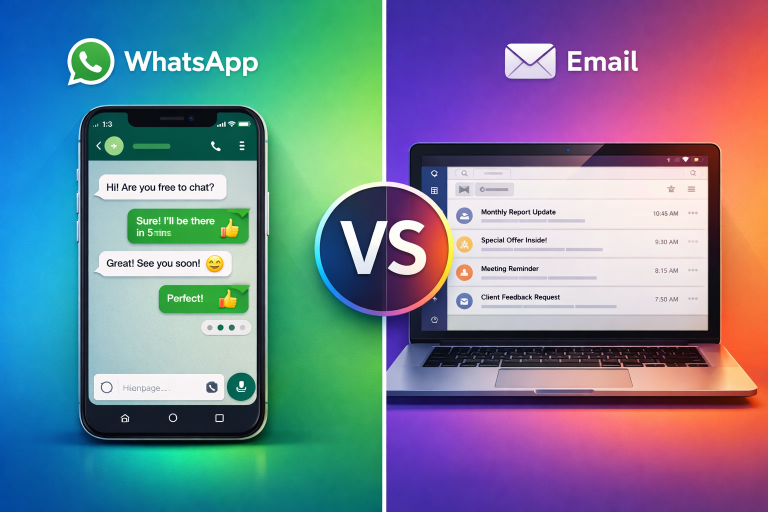
- WhatsApp:
Personal, conversational, and quick - Email:
Formal, detailed, and structured
Choose based on how you want to communicate with your audience.
3. Content Format in WhatsApp vs Email Marketing
When analyzing whatsapp vs email marketing, the content format plays a key role in how effectively your message is delivered. Each platform supports different types of content, depending on your communication goals and audience preferences.
- WhatsApp: Best for short messages, images, videos, and quick updates
- Email: Ideal for long-form content, newsletters, and detailed offers
Choosing the right format helps improve engagement and ensures your message reaches the audience in the most effective way.
4. Conversion Rates: WhatsApp vs Email Marketing
When comparing whatsapp vs email marketing, conversion rates depend on how quickly and effectively you engage your audience. WhatsApp marketing often delivers faster responses and higher conversions due to its instant and personal communication style. In contrast, email marketing is better suited for long-term nurturing and building strong customer relationships over time.
- WhatsApp: Faster responses and quick conversions
- Email: Best for lead nurturing and long-term engagement
Using both strategically can maximize your overall conversion potential.
5. Cost and Accessibility in WhatsApp vs Email Marketing
Cost and accessibility are important factors for businesses of all sizes When evaluating whatsapp vs email marketing. WhatsApp marketing is cost-effective and simple to use, making it ideal for quick communication without heavy investment. On the other hand, email marketing requires tools but provides powerful features like automation and scalability.
- WhatsApp: Cost-effective and easy to use
- Email: Requires tools but offers automation and scalability
Choosing the right platform depends on your budget and long-term marketing goals.
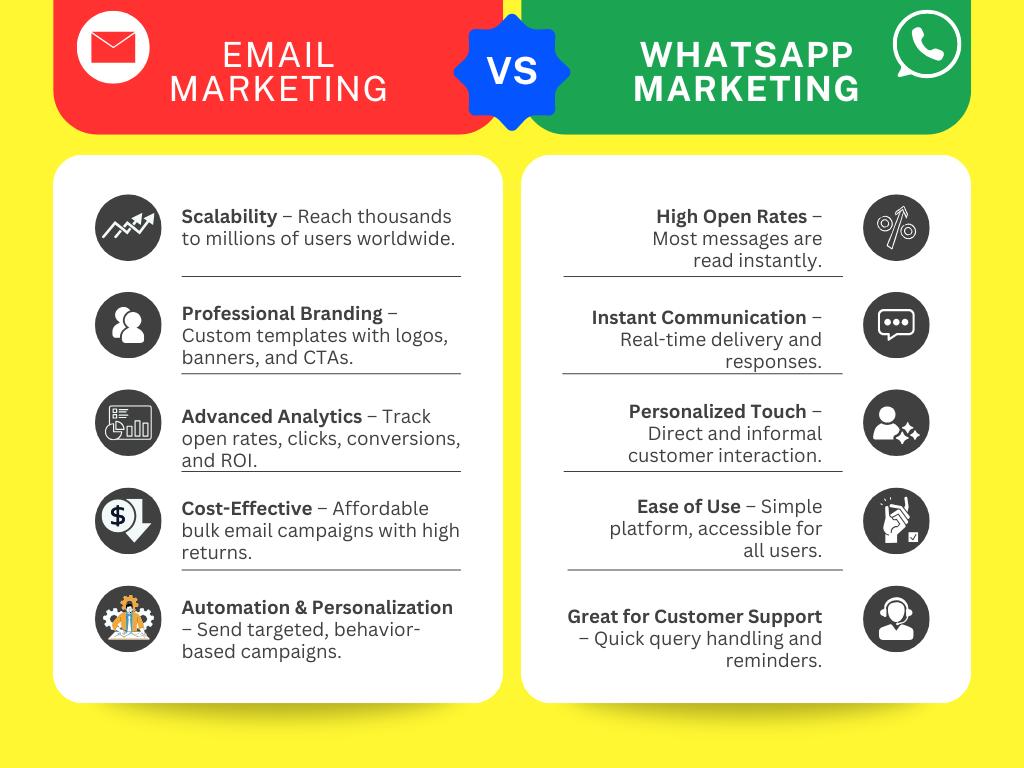
To understand industry trends, explore detailed insights on whatsapp vs email marketing comparison from trusted sources that highlight performance, ROI, and user engagement.
Benefits of WhatsApp Marketing
When comparing whatsapp vs email marketing, WhatsApp stands out for real-time communication.
Key Benefits:
- Higher open and response rates
- Direct and personal interaction
- Builds strong customer relationships
- Great for small businesses and local marketing
Perfect for quick engagement and instant communication.
Benefits of Email Marketing
Email still plays a strong role in the whatsapp vs email marketing debate.
Key Benefits:
- Ideal for professional communication
- Supports automation and segmentation
- Best for long-form and detailed content
- Helps in lead nurturing and brand building
Perfect for long-term marketing strategies.
WhatsApp vs Email Marketing: Which is Better for Business Growth?
There is no one-size-fits-all answer in whatsapp vs email marketing. The best choice depends on your business goals.
Choose WhatsApp Marketing if you want:
- Instant communication
- Quick responses and conversions
- Personal engagement with customers
For practical insights, check out this whatsapp marketing strategies and examples guide to learn how brands improve engagement and build customer relationships.
Choose Email Marketing if you want:
- Detailed communication
- Long-term customer relationships
- Scalable marketing campaigns
Best Strategy: Use Both Together
Instead of choosing one, the smartest approach is to combine both channels.
How to use them together:
- Use email marketing for detailed content and campaigns
- Use WhatsApp marketing for quick follow-ups and updates
This creates a powerful multi-channel strategy that improves engagement and conversions.
Best Practices for WhatsApp vs Email Marketing
To get the best results, follow these simple tips:
- Avoid spamming users on both platforms
- Personalize your messages for better engagement
- Use clear call-to-actions (CTAs)
- Analyze performance and optimize regularly
Always focus on delivering value-driven content.
Conclusion
The debate of whatsapp vs email marketing is not about which is better overall, but which is better for your specific goals. Both channels have their strengths and can deliver excellent results when used correctly.
For businesses in 2026, success lies in using the right mix of communication channels. By combining WhatsApp’s instant engagement with email’s long-term strategy, you can create a strong and effective marketing approach.
The future of digital marketing is not choosing one channel—it’s integrating multiple channels for better results.